
How One Wheelchair User Invented a Better Catheter Stabilization Device
After 30 years of navigating life with a spinal cord injury, Michelle Drake turned firsthand experience into an FDA-registered innovation designed to improve comfort, mobility and catheter stabilization.
A wheelchair user for 30 years, Michelle Drake has become a master problem-solver.
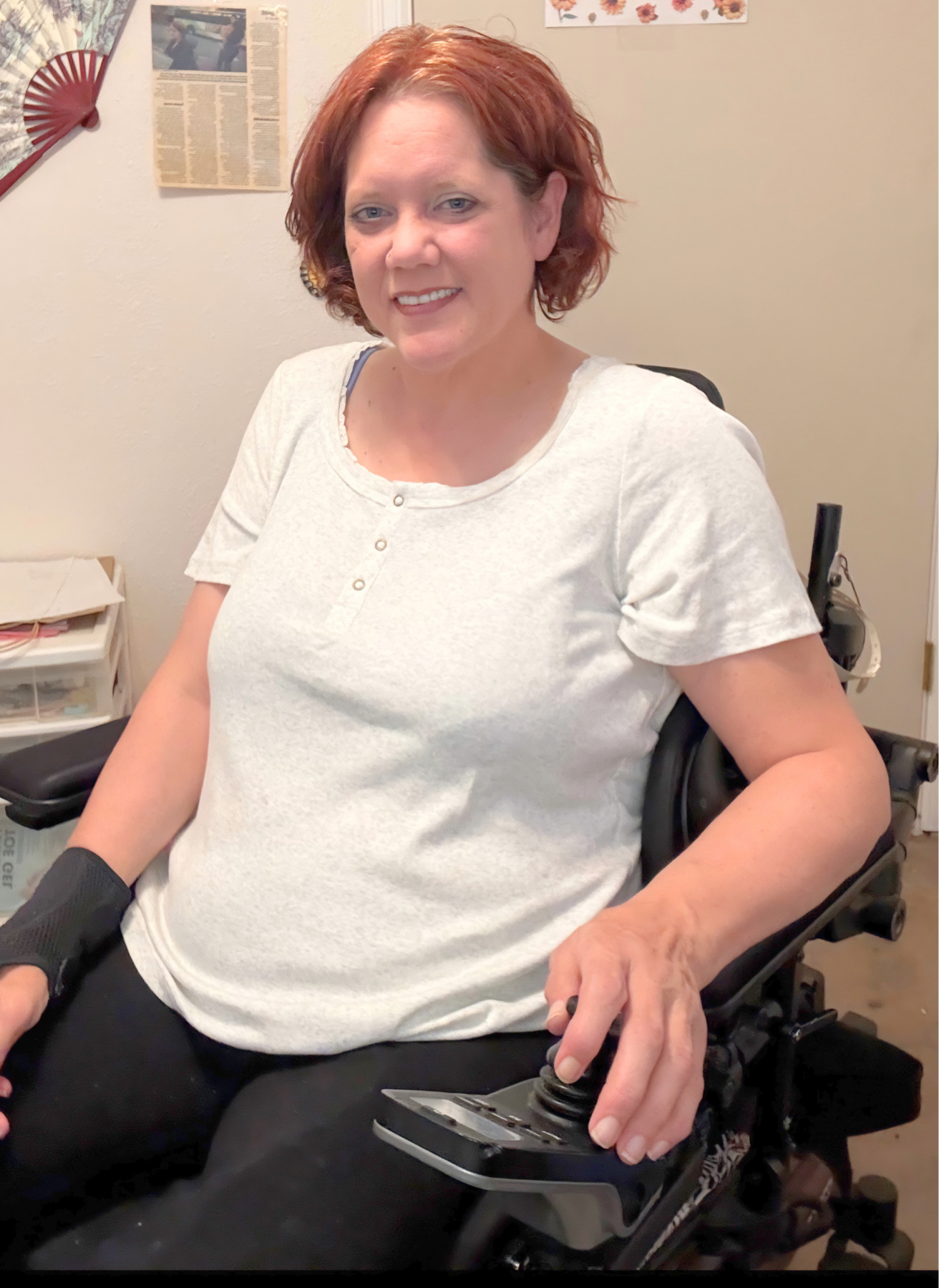
At 18, she suffered a spinal cord injury in a “nasty car accident” that left her a T6 paraplegic. Since then, Drake has gotten used to navigating a world that isn’t built for wheelchair users.
“Being in a wheelchair for 30 years, I’ve had to find a lot of workarounds,” Drake said. “The disabled community is filled with smart people because we have to navigate through stuff that doesn’t work and figure out a way to make it work.”
For Drake, that “make-it-work” mentality led her to create the Drake Lock & Swivel, a patented catheter stabilization device for indwelling catheter users. It’s the only device on the market that swivels, and it doesn’t rely on strong adhesives for anchoring.
Drake came up with the idea out of necessity.
“Every other catheter stabilization device on the market forced a trade-off,” Drake said. “You either got comfort, or you got mobility. I wanted both.”
Noting that catheters haven’t changed much over the past three decades, Drake was convinced there had to be a better way. So, she set about creating it.
Using the firsthand knowledge she’s gained as a longtime user of indwelling catheters, Drake studied the products already on the market. She was intent on creating a device that swiveled and didn’t rely on strong adhesives for anchoring, which studies have shown can benefit people who rely on indwelling catheters.
“Statistics confirm that a swiveling stabilization device can help reduce CAUTIs (catheter-associated urinary tract infection), and because it isn’t anchored with a strong adhesive, it completely eliminates the threat of Medical Adhesive-Related Skin Injury (MARSI),” she said.
Drake worked with her father, a retired machinist, to build a prototype for her own use. The invention quickly garnered attention.
“My biggest cheerleader has been my urologist,” Drake said. “When the urologist and the nurses saw it, they said, ‘You’ve got to patent this and get it on the market.’”
A few months later, when Drake had surgery, her surgeon commented on the device.
“In all honesty, I got tired of hearing my urologist and all of these healthcare professionals ask if it was on the market,” Drake recalled. “So, I looked into a patent application, and the doors continued to open.”
An initial patent search revealed what Drake already knew: there wasn’t really a device on the market that sought to provide both comfort and mobility. She painstakingly worked through the process of applying for the patent, and after receiving that, began working to get the Drake Lock & Swivel on the market.
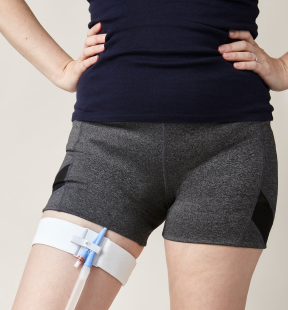
“I had to find a manufacturer who worked with tooling and plastic injection molding, and I found one,” Drake remembered. “And then we started producing it.”
What began as a simple fix has now become Drake’s focus. She launched her company, Invomed LLC, in 2021, and has since registered the Drake Lock & Swivel with the FDA and achieved HCPCS reimbursement through the Centers for Medicare & Medicaid Services (CMS).
As Drake begins building the distribution strategy for her invention, she’s excited about the future. She recently spoke at the National Distribution and Contracting Exhibition, providing a national stage to tell her story, and is exploring future opportunities.
“While the Drake Lock & Swivel was developed for indwelling catheter users, the device has broader potential,” she said. “Anywhere you have a cord coming out of your body, this device can stabilize it and allow it to swivel with your body.”
Drake is already exploring other applications for PICC lines, IV therapy, kidney filtration and wound care systems, envisioning the Drake Lock & Swivel as a universal stabilization solution for a wide range of medical tubing.
“The opportunities are just enormous,” she said.
Your Story Matters to Us.
Michelle Drake’s story is just one example of how lived experience drives real innovation. Read more client profiles and mobility stories on the Let’s Get Moving Journal.
More Stories
Related Articles
Try Everything
Five years after a spinal cord injury, Makayla Noble is embracing a new adventure: moving into a home with her sister, Myriah Five years ago,…
How One Wheelchair User Invented a Better Catheter Stabilization Device
After 30 years of navigating life with a spinal cord injury, Michelle Drake turned firsthand experience into an FDA-registered innovation designed to improve comfort, mobility…
NSM Medical Supplies Bring Peace of Mind to Families
How consistency and clear communication from National Seating and Mobility help Anita Sedillo and her son focus on what’s most important At-a-Glance Summary: For parents…