
Robotic Arms for Wheelchairs: How They Restore Independence
Learn how wheelchair-mounted robotic arms work, who may benefit from them, how to get one and how assistive technology can help people with limited upper-extremity function live more independently.
Experts: Kelsy Brown, Occupational Therapist, OTD, OTR/L and Sara Gaver, robotic arm user
A wheelchair-mounted robotic arm is an assistive device that attaches to a power wheelchair and mimics the natural movements of the shoulder, elbow, wrist and hand. It allows people with little to no arm strength — including those with ALS, muscular dystrophy, spinal muscular atrophy, spinal cord injury, multiple sclerosis or cerebral palsy — to perform daily tasks independently, from eating to opening doors.
Quick Takeaways
- Wheelchair-mounted robotic arms, like the Jaco Assistive Robotic Arm, perform reaching and grasping for users with little to no arm strength.
- Good candidates have significant upper-extremity limitations, a strong desire for independence and the ability to safely operate a Group 3 power wheelchair.
- The arm draws power from the wheelchair’s battery and is controlled through the chair’s existing joystick or alternative access method.
- Getting one involves an evaluation, a hands-on trial with a therapist, documentation of medical necessity and insurance prior authorization.
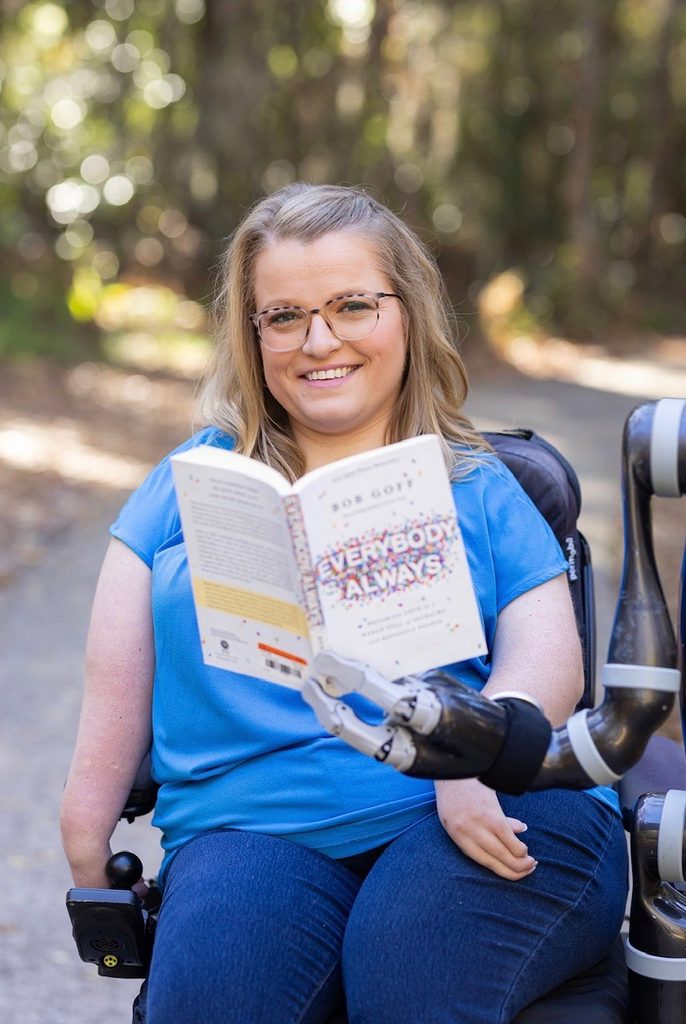
Before receiving a Jaco Assistive Robotic Arm in 2021, Sara Gaver couldn’t independently take herself to the bathroom, do her hair and makeup or complete many household chores. Today, she uses the wheelchair-mounted robotic arm for everything from eating and drinking to cooking and opening doors.
“The independence and confidence you get from doing things on your own are otherworldly,” Gaver said. “It kind of gives you that boost to start doing other things — maybe you just leave your house, or you get to go out and do fun things in the community. That little bit of confidence each day makes you a stronger individual overall.”
Sara’s story is a prime example of how the right assistive technology can help users maintain mobility and gain independence.
What Are Robotic Arms?
Robotic arms, like the Jaco Assistive Robotic Arm, are assistive devices that can be mounted directly to the user’s power chair. Robotic arms mimic the natural movement of the shoulder, elbow, wrist and hand, so that people with little to no arm strength can perform independent activities they previously couldn’t do on their own, from making coffee to pushing an elevator button or picking up something off the floor.
How Do You Know If You’re a Good Candidate for a Robotic Arm?
According to Kelsy Brown, Occupational Therapist, OTD, OTR/L and a product specialist with Partners in Medicine, good candidates for a robotic arm understand their upper body limitations but also crave independence.
“A good candidate for a robotic assistive arm is someone with upper-extremity limitations who has a strong desire for greater independence,” Brown said. “They also need to be able to safely operate a Group 3 power wheelchair.”
So, how do you know if you’re a good candidate for a robotic arm? Let’s break that down:
1. You Have Little to No Arm or Shoulder Function.
Robotic arms are designed for users with little to no arm strength, which makes independently performing activities of daily living difficult or impossible. The device mounts to the wheelchair and mimics the natural movements of the shoulder, elbow, wrist and hand, so the user doesn’t have to supply the muscle to complete the movements.
People with a variety of conditions may benefit from a robotic arm, including:
- ALS
- Muscular dystrophy (MD)
- Spinal Muscular Atrophy (SMA)
- Spinal cord injury (SCI)
- Multiple sclerosis (MS)
- Cerebral palsy (CP)
Robotic assistive arms are different from powered arm supports, which are designed for people who have some arm strength but tire easily or can’t sustain the effort. Powered arm supports allow users to use their own arm, while robotic assistive arms do the grasping and reaching for you.
2. You Already Use a Group 3 Power Wheelchair.
Medicare defines Group 3 power wheelchairs as combination indoor-outdoor motorized wheelchairs reserved for people whose mobility is severely limited due to neurological conditions, myopathies or skeletal deformities and require CRT equipment full-time to maintain mobility. Robotic assistive arms draw power from the wheelchair’s battery and integrate into the chair’s existing drive controls.
Because robotic assistive arms require a power source and a chair infrastructure that supports mounting, it can’t be used with manual wheelchairs or scooters.
3. You Can Safely Operate Your Wheelchair’s Controls.
Users control robotic assistive arms using the same controls used to drive their power chairs — typically a joystick, but can also include sip-and-puff, head arrays and more. If a CRT user lacks the motor control, cognitive ability or vision to control their power chair, a robotic arm may not be an appropriate option.
How Do Robotic Assistive Arms Help Users Regain Independence?
Robotic Assistive Arms allow CRT users with limited arm strength to complete everyday tasks many people simply take for granted, such as feeding themselves, turning on the lights or taking medication. For robotic arm users, the technology offers greater independence and protects dignity.
“Because of the arm, I was able to drop from 24-hour care down to just four hours of care a day,” Gaver said. “At this point, it’s probably easier to list the things I don’t do with my robotic arm because the things I can do with the arm is mighty long.”
Gaver’s experience isn’t unusual. Research has shown that using the Jaco Assistive Robotic Arm could potentially reduce caregiving time.
“Ultimately, the Jaco gives individuals greater freedom and independence while also reducing their reliance on others for assistance throughout the day,” Brown said.
Robotic assistive arms can help users complete countless tasks on their own, including but not limited to:
- Taking a drink
- Brushing teeth
- Opening a door to leave or enter a home
- Operating the TV remote
- Turning light switches on and off
- Retrieving items from shelves
- Handing items to another person
- Shaking hands during introductions
- Participating in hobbies
- Opening the refrigerator or using a microwave oven
- Feeding themselves or setting the table
How Do You Get a Robotic Arm?
Getting a robotic arm follows a structured process similar to other complex rehab technology. It involves the CRT user’s physical or occupational therapist, an Assistive Technology Professional (ATP) and a product specialist from the company that manufactures the robotic arm.
The process typically includes:
- Specialty evaluation: An occupational or physical therapist assesses the user’s physical abilities, goals and home environment to determine if they are a good candidate for a robotic arm.
- Trial period — A product specialist brings the arm to the user’s wheelchair for a hands-on trial. The user practices functional tasks related to their personal independence goals.
- Documentation — The clinical team documents medical necessity, including why the device is the most appropriate solution and what less costly alternatives have been tried.
- Prior authorization — The CRT provider submits the evaluation, prescription and supporting documentation to the user’s insurance carrier for approval.
- Delivery and training — Once approved, the arm is mounted, and the user receives training on operation, maintenance and troubleshooting.
“We travel to the evaluation, mount the robotic arm on the individual’s wheelchair and teach them how to operate it,” Brown said. “The individual then uses the arm to complete functional tasks related to their personal independence goals.”
How Hard Is It to Learn to Use a Robotic Arm?
Robotic assistive arms are designed to be intuitive, especially for individuals who already use a power chair, which often makes the learning curve a little easier.
“During an initial trial, most individuals can learn to complete functional tasks such as bringing a cup or utensil to their mouth, opening a door and picking items up from the floor,” Brown said.
Product specialists like Brown as well as ATPs can help users become more fluent in controlling the robotic assistive arm, while Partners in Medicine (the provider of Jaco) maintains a robust online catalog of training videos.
For Gaver, learning to use the arm wasn’t incredibly difficult, but she may have had a head start.
“I already drive a minivan with a joystick, so I’d already trained my brain on big technology with lots of movements from a tiny joystick,” she said. “I was a pretty quick learner.”
What took a little more time, Gaver says, is gaining the confidence to use the arm for certain things. For the first three years with the robotic arm, Gaver didn’t take herself to the bathroom. Over the past year, she decided there “had to be a way,” and connected with another user with a similar diagnosis who walked Gaver through her process.
“I thought if she could do it, I should be able to do it,” Gaver said. “Taking myself to the bathroom has given me so much freedom, because then I don’t need somebody during the day, which is a big deal.”
Ready to Take the Next Step?
Want to learn more about robotic assistive arms or think you’d be a good candidate? NSM’s experts will work alongside your care team to identify the right device, schedule a trial and navigate insurance.
More Stories
Related Articles

Robotic Arms for Wheelchairs: How They Restore Independence
Learn how wheelchair-mounted robotic arms work, who may benefit from them, how to get one and how assistive technology can help people with limited upper-extremity…
Power Wheelchair Joystick Alternatives & Smart Safety Technology
How eye gaze, sip-and-puff, head arrays and drive assist systems help people with limited hand movement stay mobile, safe and independent. At a Glance Power…
Bionic Assistive Devices: Robotic Arms, Exoskeletons & Smart Wheelchair Technology
A Guide to Today’s Assistive Technologies Reviewed by: Kelsy Brown, OTD, OTR/L Lindsey Sharpe PT, DPT, ATP Taking a sip of water. Standing at the kitchen counter…