

SEATTLE MOMENTUM ACADEMY EDUCATION & TECHNOLOGY EXPO
Thursday, October 15, 2026
McGavick Conference Center at Clover Park Technical College
Lakewood, WA
Event Highlights
- Earn up to 6 hours of continuing education (CE) credits for PT, PTA, OT, COTA, ATP
- Network with industry professionals
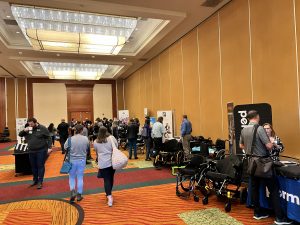
- Exhibit hall with the latest assistive technology
- Breakfast and lunch provided
The rate is: $69 for up to 6 CE credits
ACCOMODATIONS
Hotel recommendations close to the venue:
- Comfort Inn & Suites Lakewood
- $143 (2.9 miles from event). Click here to reserve a room.
- Holiday Inn Express Tacoma South
- $146 (2.3 miles from event). Click here to reserve a room.
-
TownePlace Suites Tacoma Lakewood
SCHEDULE OF EVENTS
7:00am - 7:45am: Registration
7:45am - 8:00am: Kick-off
8:00am - 12:00pm: Education Courses
12:00pm - 1:00pm: Lunch
1:00pm - 5:00pm: Education Courses
The Supplier Exhibit Hall will be open throughout
the day with 2 hours of unopposed exhibit hall time.
Click here to view full event schedule.
Continuing Education Courses
The Drive for Function and Development: Alternative Drive Control Considerations for Early Power Mobility
0.1 CEU / Beginner
Presented by: Ben Ostler, OTR/L, ATP, CLT
Quantum Rehab
Assessing an end user for power mobility can be an intimidating task. Decisions that are made will have an impact on the individual’s quality life, functional mobility, physical well-being, and social interactions. This task can seem even more daunting when it comes to the pediatric end user. Children have the natural desire to move, explore, and learn. Research has shown that there is a strong correlation between self-initiated mobility and the development of visual, cognitive, social, language, and perceptual skills. This course will discuss the characteristics and decision-making process for alternative drive control devices, as well as the special considerations on early power mobility intervention. Potential assessment and training tools for pediatric power mobility will also be explored.
Custom Molded Seating: From Historical Foundations to Modern Practice
0.1 CEU / Beginner
Presented by: Catherine Sweeney, PT, ATP/SMS,
Matrix Seating
For individuals with complex postural needs, the quality of a custom seating system directly shapes their ability to participate in the occupations that matter most — from completing work tasks to engaging in meaningful social roles. When seating fits with precision, clients are freed from compensatory movement, fatigue, and discomfort, unlocking greater access to daily life. Yet inconsistencies in shape capture, material selection, and fabrication have historically contributed to poor outcomes and costly remakes that delay client progress.
This 1-hr course traces the evolution of custom molded seating over the past 50 years, examining key milestones alongside advancements in shape capture techniques and material science. Participants will explore how foundational molding methods gave way to modern capture techniques and emerging materials that impact clinical outcomes including pressure management, posture, and microclimate control. Emphasis is placed on improving clinical decision-making, fostering interdisciplinary collaboration, and reducing remakes through digital workflows — ultimately supporting improved occupational outcomes in self-care, feeding, and functional communication.
.
Seating Foundations Part 1: Linear Measurements for Mat Evaluation
0.1 CEU / Beginner
Presented by: Ben Ostler, OTR/L, ATP, CLT
Quantum Rehab
This course will take time to explore the foundation of a mat evaluation looking into how measuring a client properly can translate into the appropriate equipment recommendations. Without an in-depth mat assessment to start the equipment recommendation process, you are leaving the outcome to chance. Every client is unique as are their seating and positioning needs. The key way to identify these unique needs comes in the form of the mat evaluation. This class provides an overview of what a mat evaluation should be comprised of, what positioning and orthopedic factors should be assessed, along with examples of proper linear measurement techniques and assessment. This course helps to bridge a gap that exists between ATPs and clinicians to bring the two together as a team who can better collaborate and come up with the optimal outcomes desired. We will follow a standardized wheelchair assessment form to complete anatomical linear measurements and apply these measurements to a seating set up.
Clinical Implication for Power Wheelchair Technology
0.1 CEU / Intermediate
Presented by: Lisa Rotelli
Invacare/ASL
This course will review the complexity of patients with the most involved bodies. People with limited access points that are speech impaired, mobility impaired and need to have support to access technology.
We will discuss the integration of controls to connect technology that can optimize solutions for clients with limited control.
Integrating Expertise: Speech-Language Pathologists Collaborating with OT/PT for High-Tech AAC Evaluation and Treatment
01. CEU / Beginner
Presented by: Krissy Lofland, MS, CCC-SLP
RM Speech
This course is designed to provide professionals with an in-depth understanding of augmentative and alternative communication (AAC) types, with a focus on high-tech AAC solutions. Course emphasizes the importance of a multidisciplinary team approach, demonstrating how speech-language pathologists, occupational therapists, & physical therapists can work together for eval/treatment.
Clinically Speaking: The Difference Between Standard and Complex Rehab PWCs
0.1 CEU / All Levels
Presented by: Ben Ostler, OTR/L, ATP, CLT
Quantum Rehab
This course will discuss the minimum performance characteristics, capabilities, and limitations of each power wheelchair group to help clinicians and supplier ATPs match the consumer’s needs to the technology solutions available.
When You Know Better, You Can Do Better. A course highlighting learning opportunities through less-than-ideal initial outcomes
0.1 CEU / Intermediate
Presented by: Daniella Giles, PT, DPT, ATP/SMS
Sunrise/Ride
When providing custom seating systems, successful outcomes are dependent upon proper execution of standardized procedures including: A thorough discussion of needs, detailed mat assessment, precise measurements, accurate installation of components, individualized fitting protocols, and follow up appointments for fine tuning. Seems easy enough, right? A missed opportunity at any of these steps can leave the recipient with unintended struggles. How do we move past obstacles that inevitably arise during the process? This course is designed to highlight my personal experiences of overcoming inadvertent errors, strategy changes and less than desired outcomes.
Changes with Age: Giving You the Justification for Custom Manual Wheelchairs for the Geriatric Client
0.1 CEU / Beginner
Presented by: Petra Conaway, PT, DPT, ATP/SMS
Motion Composites
The geriatric client can be easily overlooked as one who could benefit from a custom fitting, ultralightweight, adjustable manual wheelchair. They are too often provided the “basic” wheelchair without much thought. This course with review normal physiological changes that come with aging, and how proper wheelchair seating, base selection, fitting, and set up, can be justified for the geriatric client.
Prescriptive Planning - Turning Chaos Into (an) Order
0.1 CEU / Intermediate
Presented by: Lauren O'Rourke, PT, DPT, ATP, CPST
Etac/Ki Mobility
Every wheelchair fitting starts with a good eval, from client history to equipment trials, to careful measurements (and let’s not forget to get the rider’s and caregivers’ thoughts on what matters to them). Once we have funding, we do our delivery and fitting and we’re done with that rider for the next 5 years, right? We know that’s not the case at all. Riders change. Whether it’s growth, weight changes, changes in the rider’s condition, or evolution of wheelchair skills, riders change. Can the chair you prescribed change with them?
In this session, we are going to look at a variety of the decisions that you often face when configuring a chair and help navigate some of options that will allow you to build future adjustments into the chair. We will discuss some of the more critical adjustments to consider, and what their impact can be on present and future performance. We will also discuss some of the set-up factors you need to consider when fitting and adjusting your chair and will offer some tips on how to avoid some of the mistakes that can rob a chair of its efficiency and performance.
Evidence-Driven MWC Configuration: Optimizing Fit and Function for Different Body Types and Propulsion Methods
0.1 CEU / Intermediate
Presented by: Sarah Lusto PT,MSPT, ATC, ATP
Permobil
This 1-hour course is designed to help providers and clinicians develop best practices for recommending complex rehab technology (CRT) manual wheelchairs for individuals with varying body proportions and propulsion styles. Using the ICF model, the course will guide participants through the decision-making process, balancing evidence with functional outcomes to ensure successful CRT seating and wheeled mobility solutions. Through case examples and clinical reasoning discussions, participants will learn to identify clients' individual clinical and functional goals, driving configuration and component recommendations that enhance functional mobility outcomes, participation, and overall satisfaction with the equipment, ensuring a good person-technology match.
Building for the Future – Comprehensive Evaluation and Interview to Address the Equipment Needs of the Pediatric Client
0.1 CEU / Intermediate
Presented by: Lauren O'Rourke, PT, DPT, ATP, CPST
Etac/Ki Mobility
Children with special healthcare needs may have many needs that differ from their typically developing peers. This may include adaptive equipment to maintain or improve health status, help them function, and meet developmental milestones. Refined assessment tools allow for early diagnoses, which then leads to early therapeutic intervention. As a result, we can anticipate what the functional impairments are going to be, and what type of equipment may be indicated.
The timing of interventions, including provision of adaptive equipment, can be a critical contributor to success in meeting therapeutic goals. Professionals involved in equipment prescription should recognize what types of equipment may be helpful, based on timing and diagnosis. This presentation will review childhood development and disability and encourage the learner to consider the scope of possible equipment needs for the child with special healthcare needs.
Tailored Seating Solutions for High-Risk Clients
0.1 CEU / Beginner
Presented by: Sarah Lusto PT,MSPT, ATC, ATP
Permobil
In the wheelchair seating arena, providing a seating system for the clients at high risk for pressure injury can be both intimidating and overwhelming. This 1-hr course provides an in-depth understanding of how to incorporate evaluation findings, seating characteristics, and client goals when formulating equipment recommendations for high-risk clients. Participants will learn to identify clinical indicators of pressure injury risk, apply ISO wheelchair cushion performance standards, and recognize key material traits in seating products. A complex case example will be discussed to illustrate the process of integrating evidence and client goals to enhance functional independence.
By the end of this course, participants will be equipped with the knowledge to make informed, evidence-based, and client-centered seating recommendations, ultimately improving the quality of life for wheelchair users.
Explore the course offerings. You can pick & choose the classes you'd like to attend.